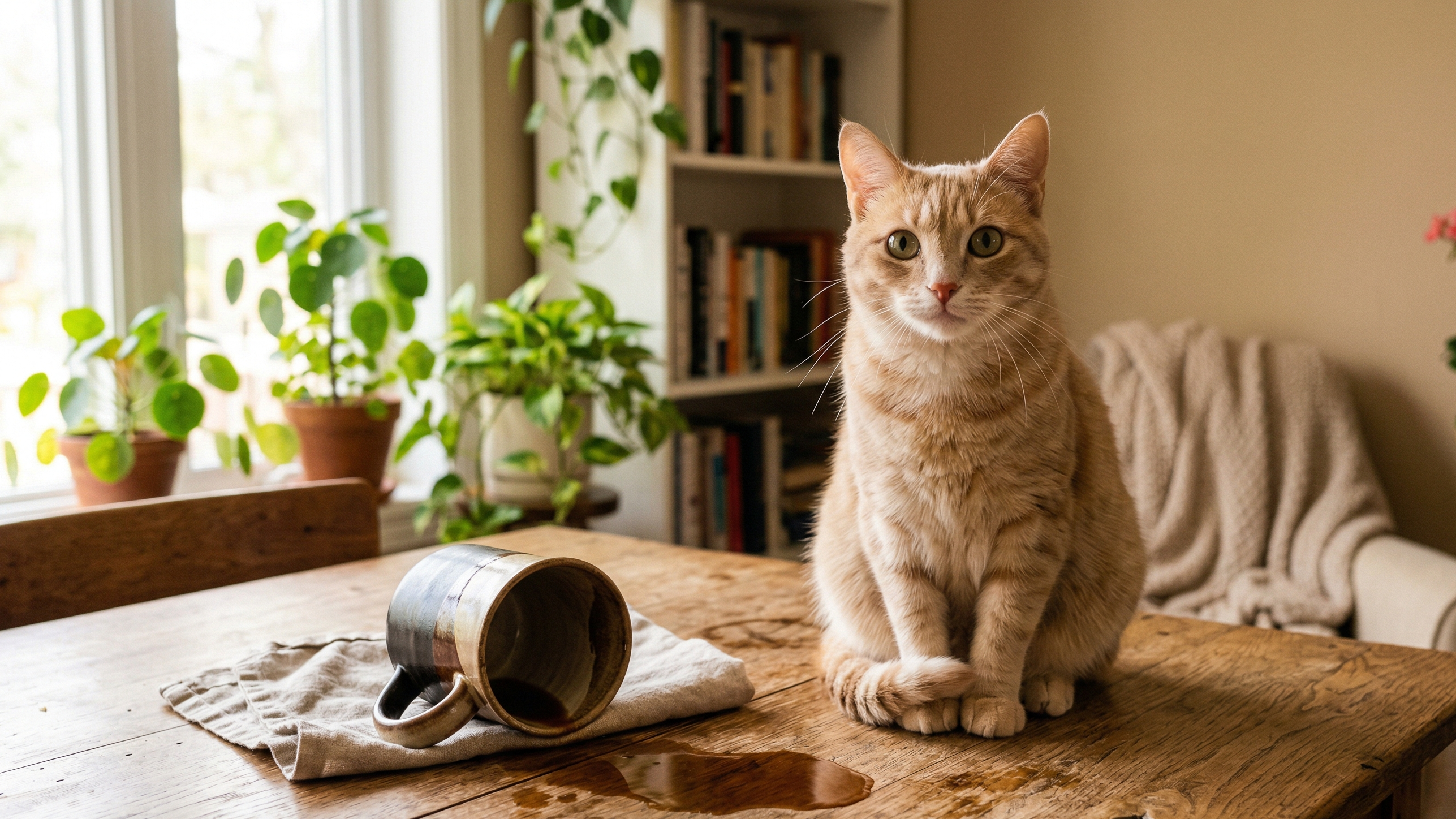
Cats knock things off tables. It's one of the most universal — and baffling — feline behaviours. You're sitting quietly, minding your own business, when your cat walks to the edge of a table, makes direct eye contact, and slowly pushes your coffee mug off the edge. Then walks away.
It's not random. It's not spite. And it's actually far more fascinating than it looks.
The Science Behind the Swat
Cats are hardwired predators. In the wild, a small movement — a twitching mouse, a rustling leaf — means the difference between eating and going hungry. Your cat's paws are extraordinarily sensitive instruments, packed with nerve endings that detect even the subtlest vibrations and textures.
When your cat bats at your water glass, they're doing exactly what evolution designed them to do: investigating a potential "prey" item. Does it move? How does it react? Is it alive? The push is a test, not an act of malice.
It's Also About Attention
Here's where it gets more interesting. Cats are quick learners. If knocking something off the table caused you to leap up, yell, or rush over last time, your cat has filed that information away carefully.
You reacted. Loudly. Immediately.
From your cat's perspective, that's a result. Cats don't distinguish between positive and negative attention the way we might hope. Attention is attention. If batting your pen off the desk reliably produces a human, your cat has discovered a very effective button.
Boredom Plays a Big Role
A mentally understimulated cat is a destructive one. Cats need outlets for their hunting instincts — the stalking, chasing, pouncing cycle that their brains are built around. Without it, they'll find their own entertainment.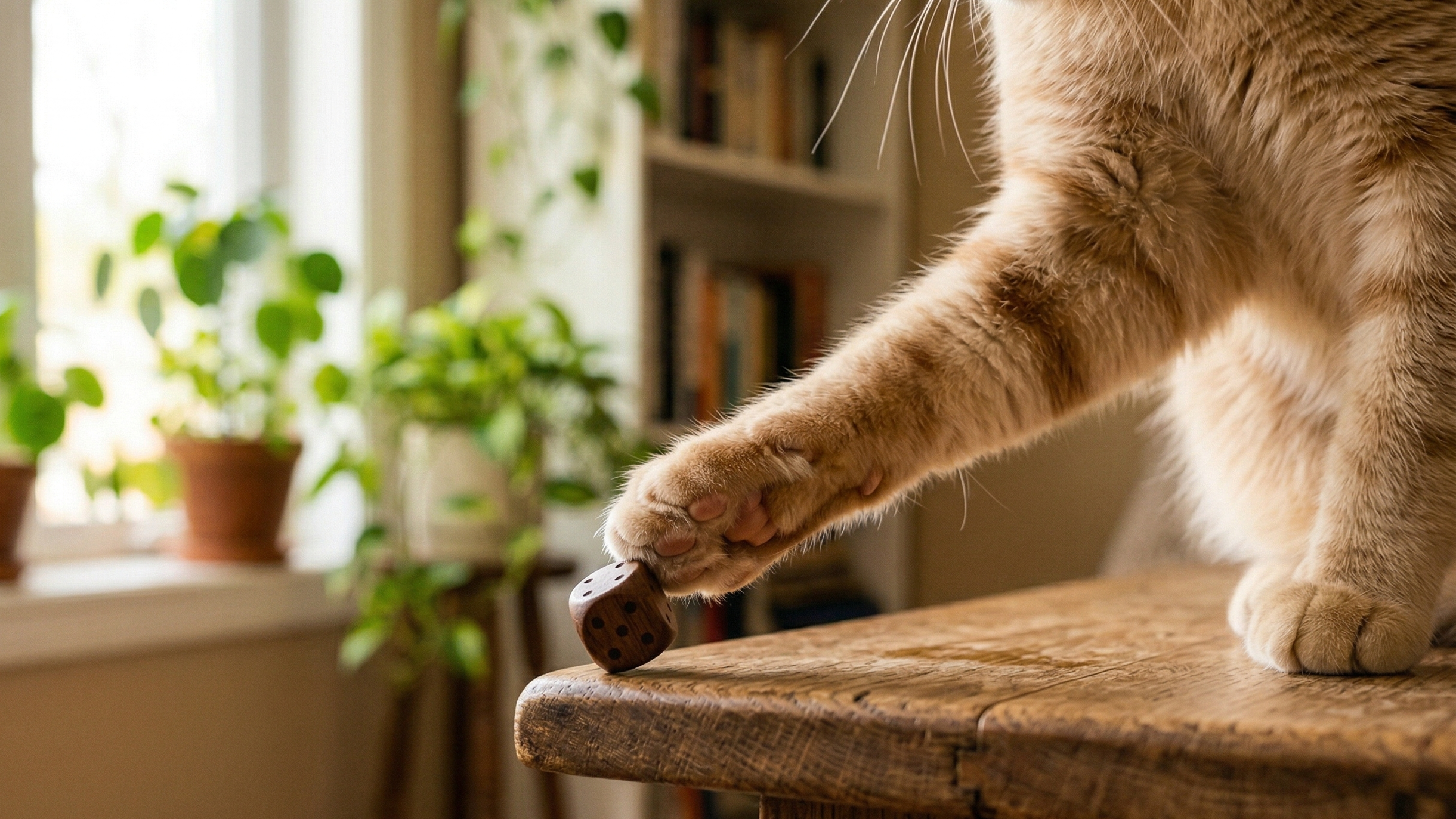
Table-clearing is often a symptom of a cat who doesn't have enough to do. If this behaviour is frequent, it's worth asking: when did your cat last have a proper play session?
Interactive play — the kind where something moves unpredictably — is the most satisfying for cats. This is why a simple laser pointer or a darting bird on a screen can hold a cat's attention far more effectively than a static toy sitting in the corner. Apps like CatVerse were designed with exactly this instinct in mind, giving cats moving targets that respond to their touch, mimicking the stimulation of a real hunt.
What You Can Actually Do
Scheduled play sessions work. Two 10–15 minute play sessions per day — ideally once in the morning and once before bed — significantly reduce boredom-driven mischief. A tired cat is a well-behaved cat.
Don't react dramatically. If table-clearing has become an attention-seeking behaviour, the worst thing you can do is reward it with a big reaction. Calmly pick up the item, don't make eye contact, and move on. This takes patience, but it works.
Give them legal alternatives. A cat tree near a window, puzzle feeders, or rotating toys give your cat other outlets for their curiosity and energy. The goal is to make the approved activities more interesting than the forbidden ones.
Secure genuinely valuable things. Some cats will always be browsers regardless of how enriched their environment is. For breakables or important items, storage is simply the more practical solution.
Understanding, Not Frustration
The table-clearing cat isn't being difficult. They're being a cat — curious, stimulation-seeking, and highly attuned to cause and effect. Once you understand the behaviour, it stops feeling personal and starts feeling almost logical.
The best long-term solution is always the same: more play, more enrichment, and a little less stuff on the table edge.
If your cat needs more interactive stimulation, CatVerse gives them moving targets to hunt directly on your phone or iPad — satisfying that chase instinct without sacrificing your belongings.